


Thread Milling vs. Tapping
In the world of machining and manufacturing, creating threads in holes is a common process. Threads are used to fasten parts together with screws or bolts. There are two main ways to create these threads: tapping and thread milling.
Both methods are widely used, but they have key differences in how they work, what tools they use, and the types of jobs they're best suited for. This article will help you understand the differences between thread milling and tapping in simple terms. Whether you're a beginner or someone looking to improve your understanding, this guide will give you the knowledge you need.
What is Tapping?
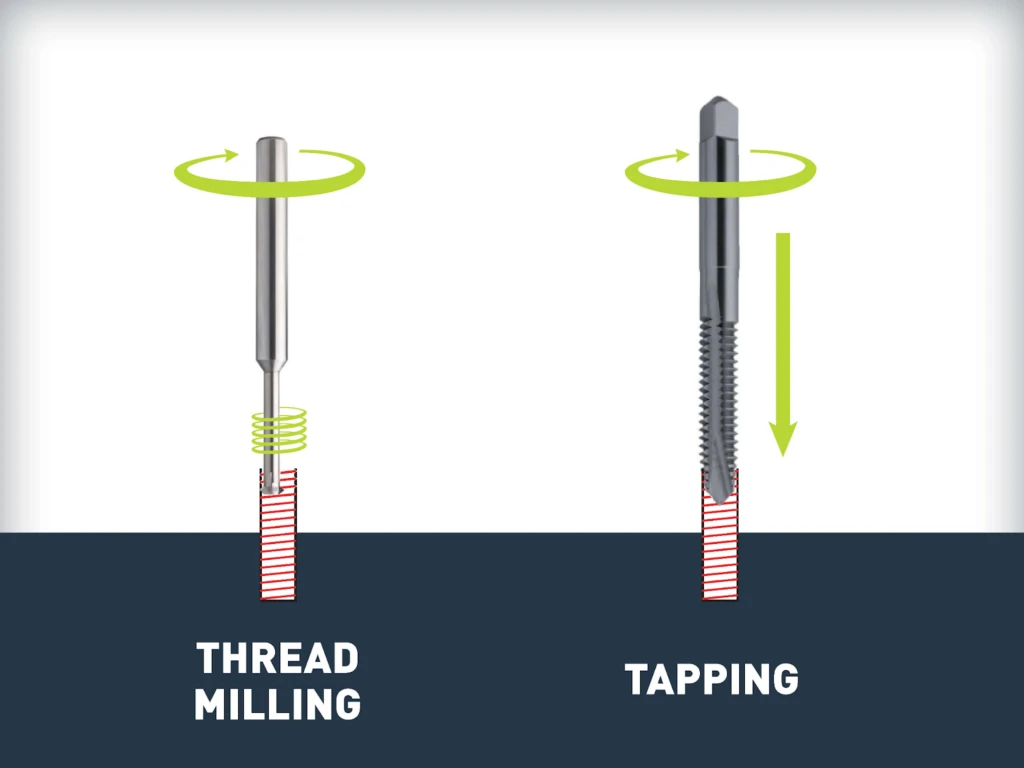
Tapping is the process of cutting threads inside a hole using a tool called a tap. The tap looks like a bolt with cutting edges. As it turns into the hole, it cuts the thread in one pass.
There are two types of tapping:
Hand tapping: Done manually using a handle.
Machine tapping: Performed by a machine such as a CNC milling machine or a drilling machine.
Tapping is a fast and simple process, which makes it very popular in mass production and small workshops alike.
Advantages of Tapping:
Fast production: Tapping is quicker because it cuts the thread in one pass.
Simple tooling: Taps are easy to set up and use.
Low cost: Taps are generally inexpensive and widely available.
Ideal for blind holes: Some taps (like spiral taps) are good for holes that don't go all the way through the material.
Disadvantages of Tapping:
Less flexible: Each tap size is for one thread size only.
Risk of breakage: Taps can break easily, especially in small sizes or hard materials.
Difficult chip removal: Chips may get stuck in the hole and cause tool damage.
Hard to adjust: Once the thread is cut, it cannot be resized or adjusted.
What is Thread Milling?
Thread milling uses a thread mill, a cutting tool that moves in a helical (spiral) path to cut the thread into a hole. Unlike tapping, thread milling is usually done on a CNC machine.
Thread milling removes the thread material gradually. The cutter moves around the inside of the hole and slowly cuts the threads.
There are two types of thread mills:
Single-point thread mills: These cut one thread at a time and are flexible for different sizes.
Multi-tooth (full form) thread mills: These cut multiple threads at once and are faster but less flexible.
Advantages of Thread Milling:
Flexible tool use: One tool can be used for different thread sizes and types (internal and external).
Less tool breakage: Thread mills are less likely to break because the cutting force is lower.
Better chip control: Chips are removed gradually, which reduces clogging.
High accuracy: Thread milling gives more precise threads with better surface finish.
Adjustable threads: You can fine-tune the thread size by adjusting the tool path.
Ideal for hard materials: Thread mills are better for hard metals like stainless steel or titanium.
Disadvantages of Thread Milling:
Slower than tapping: Especially when using single-point thread mills.
More expensive tools: Thread mills cost more than taps.
Requires CNC machines: Thread milling can't be done manually, so it needs a CNC machine.
More programming required: You need to write a program for the tool path in CNC.
Key Differences Between Thread Milling and Tapping
1. Process and Tools
Thread Milling: Uses a rotating thread mill that moves in a helical path to cut threads. Requires a CNC machine for precise control.
Tapping: Uses a tap that is rotated directly into a pre-drilled hole to cut threads. Can be done manually or with a machine.
2. Speed
Thread Milling: Slower because it involves multiple passes and precise tool movements.
Tapping: Faster, as it typically requires only one pass to create the thread.
3. Flexibility
Thread Milling: Highly flexible, as one thread mill can create multiple thread sizes and custom profiles.
Tapping: Less flexible, as each tap is specific to one thread size and type.
4. Precision
Thread Milling: Offers higher precision due to CNC control, making it ideal for tight tolerances or complex threads.
Tapping: Provides good precision for standard threads but may struggle with very fine or custom threads.
5. Material Compatibility
Thread Milling: Works well for a wide range of materials, including hard ones like titanium or stainless steel.
Tapping: Best suited for softer materials; harder materials can cause tap wear or breakage.
6. Tool Durability
Thread Milling: Thread mills are less likely to break because the cutting forces are distributed over a larger area.
Tapping: Taps are more prone to breaking, especially in tough materials or if not aligned properly.
7. Cost
Thread Milling: Higher initial cost due to the need for a CNC machine and skilled programming.
Tapping: Lower cost, as it can be done with simpler tools and doesn't always require advanced equipment.
8. Applications
Thread Milling: Ideal for complex parts, small production runs, or when high precision is needed.
Tapping: Best for high-volume production of standard threads in softer materials.
When to Use Tapping
Tapping is ideal when:
You need fast production.
The material is not too hard (like aluminum or mild steel).
You're working with a simple machine or doing manual work.
You need to cut many holes of the same size.
Tapping is a great option for low-cost and high-speed work. It's often used in mass production and basic manufacturing environments.
When to Use Thread Milling
Thread milling is ideal when:
You're working with hard materials like stainless steel or titanium.
You need high precision or special thread profiles.
You want to reduce the risk of tool breakage.
You have a CNC machine and want flexibility.
You need to create both internal and external threads.
You want to adjust thread size or depth later.
Thread milling is common in aerospace, medical device, and high-performance engineering industries. It gives high-quality results, even if it takes a bit longer.
Thread Milling vs. Tapping in Different Scenarios
1. High-Volume Production
Tapping wins here. It's fast and efficient for repeating the same threads in large quantities.
2. Small Batch or Custom Threads
Thread milling wins because one tool can cut multiple thread sizes, saving cost and time on setup.
3. Hard or Tough Materials
Thread milling handles difficult materials better and reduces the risk of tool breakage.
4. Blind Holes
Tapping is typically better, but with careful programming, thread milling can also work well.
5. Broken Tool Recovery
If a tap breaks in a hole, it's very hard to remove. Thread mills rarely break, and if they do, they don't jam the hole.
Final Thoughts
Both tapping and thread milling are useful methods to cut threads. The best choice depends on your materials, your machines, your production needs, and your budget.
If you want speed and low cost, and you're working with soft materials or high-volume production, tapping is your best bet.
If you want precision, flexibility, and tool safety, and you have a CNC machine, thread milling is the better option.

PowerWinx is a professional manufacturer with expertise in both thread milling and tapping processes. We offer high-precision threading solutions tailored to your specific needs. With advanced CNC capabilities and skilled technicians, PowerWinx ensures reliable, accurate, and efficient thread cutting for a wide range of materials and applications. Trust PowerWinx for quality threading every time.